Derby vs. Oxford: Which Dress Shoe Belongs in Your Closet
Published on November 16, 2026
By Sean Parks
Olivia Beyers Photography
The Quick Rundown
At a Glance:
- Oxford shoes use a closed lacing system, which gives them a trim profile and the highest formality of any lace-up.
- Derby shoes use an open lacing system, which makes them roomier, easier to adjust, and a little more relaxed.
- The two styles trace back to different origins, one to Oxford University students and one to a Prussian field marshal.
- Oxfords suit black-tie events, weddings, and formal offices, while derbies handle business-casual days and smart-casual weekends.
- Owning both covers nearly every dress code a formal wardrobe will face.
Two lace-up dress shoes dominate formal footwear, and the difference between them comes down to one detail most people never notice: how the laces attach. That single choice shapes how each shoe fits, how formal it reads, and which events it belongs at.

What Sets a Derby Apart From an Oxford
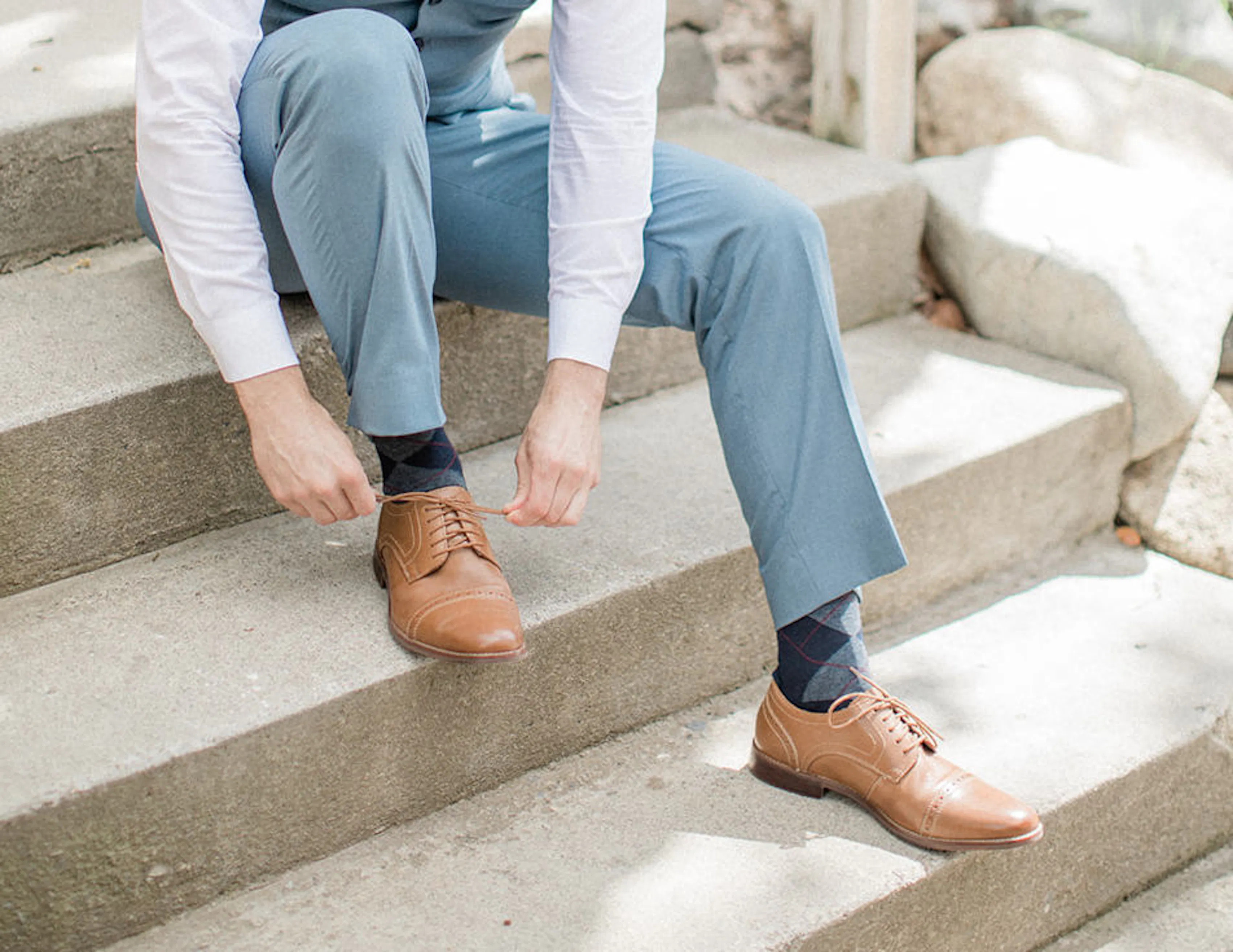
The main difference between a derby and an oxford is the lacing system. An oxford has closed lacing, where the eyelet panels are stitched underneath the vamp, the front section of the shoe. A derby has open lacing, where those same panels sit on top of the vamp and fan open freely when the shoe is untied.
On an oxford, the side quarters tuck under the front, and the laces pull together into a clean V, leaving a smooth, unbroken line across the top of the foot. Merriam-Webster defines an oxford as a low shoe laced over the instep, and that tidy closure is exactly what gives it a formal look. The panel doing the covering is the vamp, which caps the forepart of the foot.
On a derby, the eyelet tabs are sewn over the vamp, so they open outward when the laces loosen. The closely related blucher is a shoe with the quarters lapped over the vamp and laced together for closing. Because that opening spreads wider, a derby slips on more easily and gives more room across the top of the foot, which helps anyone with a higher instep or a wider foot.
Feature | Oxford | Derby |
Lacing | Closed - eyelets stitched under the vamp | Open - eyelets stitched on top of the vamp |
Profile | Sleek and trim | Roomier and more relaxed |
Formality | Highest of any lace-up | Smart to smart-casual |
Best fit for | Standard to low insteps | Higher insteps and wider feet |
Adjustability | Limited | Generous |
Where Each Shoe Comes From
Both shoes earned their names in the 1800s, but from very different places. The oxford grew out of a half-boot worn by university students, while the derby, also called the blucher in the United States, is widely tied to military footwear from the Napoleonic era.
The Oxford descends from the Oxonian, a side-slit half-boot popularized by students at Oxford University around 1825. Students wanted something lighter than the tall boots of the day, and shoemakers gradually lowered the cut and moved the laces to the instep. The name stuck as the style spread, and the term "Oxford shoe" first appeared in print in 1846.
The derby's backstory runs through the battlefield. Its Blucher name comes from Gebhard Leberecht von Blücher, the Prussian field marshal who helped defeat Napoleon at Waterloo in 1815. During the Napoleonic Wars, Blücher, remembered as one of the most aggressive Prussian commanders of the period, reportedly had a boot made for his troops with open, adjustable lacing so soldiers could pull it on quickly and march in comfort. The open-laced design outlived the war and became a civilian staple.

Rachel Girouard Photography
Which Shoe Is More Formal
The oxford is the more formal shoe of the two, and the reason is that closed lacing. Its uninterrupted line across the instep reads as dressier than the open lacing of a derby. For the strictest formal occasions, a plain black oxford is the safest formal dress shoe you can wear.
A plain-toe or cap-toe black oxford is the standard for black-tie events, semi-formal events, and formal weddings, especially in patent leather or a high-shine calf. A toe cap adds a subtle seam without lowering the formality, while brogue shoes with their decorative perforations or a lighter shade relax the look a little. Even then, an oxford outranks a derby in formality. Oxfords stay the anchor of the whole category. The global formal footwear market, valued at about $56.9 billion in 2024, counts oxfords as its largest segment, and one industry analysis put oxfords at about 31% of the men's formal shoe market.
Derbies live one notch down. A polished black derby still works with a suit for business meetings or a daytime event, but its open lacing keeps it in smart-to-smart-casual territory. Darker colors read more formal, while a brown derby leans casual. That flexibility is a feature rather than a flaw, because it makes the derby the more forgiving choice across casual and semi-formal settings.

Getty Images/iStockphoto
What to Wear Each Shoe To
Match the shoe to the dress code. Reach for an oxford when the invitation calls for formal or black-tie attire, and reach for a derby when the day leans business-casual or smart-casual. Color guides the choice too, since darker colors read most formal while a lighter shade feels more casual.
Oxfords work best for:
- Black-tie events, semi-formal events, and formal weddings, where a black oxford is the expected choice.
- Business meetings, interviews, and professional offices that call for a formal, traditional look.
- Evening receptions and other formal occasions that reward a clean, dressed-up profile.
Derbies work best for:
- Business-casual workdays that still need a real dress shoe.
- Casual occasions and daytime weddings with a relaxed dress code.
- Smart-casual weekends, where a brown derby pairs with chinos, casual trousers, or dark denim.
Color rounds out the decision. Black oxfords pair cleanly with charcoal, navy, and black suiting, while a brown or tan pair adds warmth against navy or grey and works with dress pants on their own. A derby gives you more room to show personal style in casual outfits, including a smart-casual look with an open collar or weekend casual wear.
Why Your Closet Deserves Both
Owning both an oxford and a derby covers almost every occasion without forcing one shoe to do a job it was never built for. The oxford handles your most formal moments, the derby carries the everyday, and together they span the full range of dress codes you are likely to meet.
Start with the more formal piece and build out from there. A pair of oxford shoes in black leather is the versatile foundation, ready for weddings, the office, or a night out. Add a brown or tan oxford for navy and grey suiting, then keep a derby on hand for the days that call for something easier. SuitShop carries oxfords in black, brown, and tan, and pairing them with a derby rounds out a wardrobe that answers nearly any invitation.


Dressing Both Shoes for Your Wedding Party
Weddings put both shoes to work. A black oxford finishes a tuxedo or dark suit for a formal ceremony, while a brown oxford or derby suits a relaxed daytime celebration. Once the footwear is set, the rest of the look- the suit, shirt, and accessories- falls into place around it.
For a formal or black-tie wedding, pair a black oxford with a tuxedo or dark suit in black, navy, or charcoal. For a garden or beach celebration, a brown oxford or derby loosens the look without losing polish. When an invitation leaves you guessing, SuitShop's guide to wedding dress codes for guys breaks down what each one asks for. Coordinating a wedding party gets easier when the suits match, and registering five or more wedding party members earns one free suit that is yours to keep.
Build Your Formal Wardrobe With SuitShop
The right dress shoe is only the start of a sharp formal look. SuitShop makes it easy to own the whole outfit, from oxford shoes to suits, tuxedos, and accessories you buy and keep rather than rent. Start with a pair of oxford shoes, then complete the look with everything your next formal event calls for.
Match your oxfords with a suit or tuxedo, then finish with dress shirts, ties, and accessories sized to fit. Free fabric swatches, an online Fit Finder, and free returns take the guesswork out of ordering. Explore SuitShop and put together a formal wardrobe you will reach for long after the last event ends.

Sean Parks
Sean Parks is a writer with a focus on men's suiting, formalwear, and personal style. Through his work with SuitShop, he has developed a deep understanding of suit fit, styling, wedding attire, and the details that help people feel confident in what they wear. A proud University of Georgia graduate with dual degrees in Public Relations and Communication Studies, Sean brings a research-driven approach to making suiting advice clear and approachable. When he's not writing about menswear, you'll find him logging miles on the Atlanta Beltline or playing the guitar on his back porch.
More Articles
What to Wear to a Conference, From Business Casual to Suited Up
by Sean Parks November 18, 2026

Customer Service
Contact Us
- Get In Touch
- Corporate Services
- +1 (773) 303-6006
- info@suitshop.com
Sign up for emails
© Copyright 2026 SuitShop