How to Measure for a Dress Shirt: Sized for Sharpness
Published on May 31, 2026 | Updated June 3, 2026
By Sean Parks
Everything You Need to Know Before You Buy
Getting a dress shirt that fits starts with knowing your body measurements. A well-fitting shirt depends on five key numbers: your neck size, the shirt's chest, the shirt's waist, sleeve length, and shirt length. Take those measurements once, and you'll know your size across every occasion.
At a Glance:
- Wrap a flexible measuring tape around the base of your neck to find your neck size, then match it to a size on the chart.
- Measure your chest at its fullest point, under your arms, to confirm the shirt will have enough room through the torso.
- Arm length runs from the center back of your neck, over your shoulder, and down to your wrist bone.
- Waist measurement helps you gauge how a shirt will fit through the midsection.
- Shirt length tells you whether a shirt will stay tucked or sit at the right spot untucked.
- SuitShop dress shirts use alpha sizing, so one accurate measurement is all it takes to find your size.
A men's dress shirt that fits well makes for an outfit that looks clean, sleek, and intentional. Nailing the dress shirt size gets you one that doesn't pull at the buttons, swallow the torso, or ride up the moment you sit down. Five minutes with a measuring tape fixes all of that and puts you on the path to a perfect fit every time you get dressed.
Start Here: Your Neck Measurement Drives Everything
Your neck measurement is the most direct indicator of dress shirt sizing. It determines how the shirt collar fits, whether the shirt buttons comfortably at the throat, and which size on a size chart applies to you. Every other measurement confirms the fit from there.
To find it, wrap a flexible measuring tape around the base of your neck, just above where a collar would sit. Keep the tape snug but not tight; you should be able to slip one finger underneath. That number, measured in inches, is your neck size.
SuitShop's men's dress shirts use alpha sizing—XS through 3XL—which maps your neck measurement to a single size that accounts for chest, waist, sleeve, and shirt length all at once. Here's how that breaks down:
Size | Your Neck (in) | Shirt Neck (in) | Shirt Chest (in) | Shirt Waist (in) | Sleeve Length (in) | Shirt Length (in) |
|---|---|---|---|---|---|---|
XS | 14–14.5 | 14.5 | 39 | 38 | 34 | 29.75 |
S | 14.5–15 | 15.25 | 41 | 40 | 34.25 | 30 |
M | 15.5–16 | 16 | 43 | 42 | 35 | 30.5 |
L | 16–16.5 | 16.75 | 45 | 44 | 35.25 | 30.75 |
XL | 17–17.5 | 17.5 | 47 | 46 | 36 | 31.25 |
2XL | 17.5–18 | 18.25 | 49 | 48 | 36.25 | 31.5 |
3XL | 18.5–19 | 19 | 51 | 50 | 37 | 32 |
Notice that the shirt neck measurement runs slightly larger than your actual neck. That built-in allowance is intentional. It gives the shirt collar room to sit comfortably without pressing against your throat all day.
Measure your neck first. Once you have that number, your alpha size follows directly from the chart, and all other dress shirt measurements are already accounted for.
Chest and Waist: How the Body of the Shirt Should Fit
A men's dress shirt should have enough room through the chest to move freely without pulling at the buttons. It should also follow the shape of your torso rather than hanging off it. Those two outcomes are controlled by chest and waist measurements, and getting both right is what produces a perfect dress shirt fit.
To measure your chest, wrap the tape around the fullest part, just under your arms and across your shoulder blades. Keep your arms relaxed at your sides and breathe normally. For an accurate measurement, lay the tape flat against your body without twisting it, since a twisted tape reads short and puts you in the wrong size.
To measure your waist, wrap the tape around your natural waistline, which falls just above your hip bones near your belly button. Keep the tape snug without pulling it tight.
Once you have both numbers, compare them to the shirt chest and shirt waist columns in the size chart. A few things to look for:
- If your chest measurement is close to the upper limit of a size, consider sizing up for comfortable movement
- If your waist is significantly smaller than the shirt waist in your chest size, a slim fit may give a more tailored appearance through the torso
- If your measurements fall between sizes, go up rather than down - a shirt with a little extra room always looks better than one that pulls
The difference between your chest and waist measurements also informs shirt fit preference. A bigger gap between the two means a slim-fit shirt will be more flattering. A smaller difference means a more relaxed cut will feel natural and comfortable.
Your chest drives the size you need; your waist tells you which cut will flatter your build. Both numbers together give you a complete picture of dress shirt sizing and how a shirt will fit through the body.


Sleeve Length and Shoulder Width: The Measurements Most People Skip
Sleeve length and shoulder width are the two dress shirt measurements most people skip, and they're the ones that show most obviously when they're wrong. A shirt sleeve that's too short exposes the wrist in all the wrong ways; one that's too long bunches at the cuff. And a shirt that pulls across the shoulders or hangs past the shoulder seam throws off the entire silhouette.
Measuring Arm Length
Stand with your arm slightly bent at the elbow. Start the tape at the center back of your neck, run it across the top of your shoulder to the shoulder seam, then down the outside of your arm to your wrist bone. That full number is your arm length and corresponds directly to the sleeve measurement in the size chart.
Measuring Shoulder Width
With a friend or a flat surface, measure from the edge of one shoulder to the edge of the other, straight across the back. The shoulder seam of a well-fitting shirt should sit right at the edge of your shoulder, not drooping down your arm or pulling toward your neck.
Key Takeaway
Because SuitShop uses alpha sizing, both your shirt sleeve length and shoulder width are already built into your size. A size Medium includes a 35-inch sleeve, matched to the proportions of someone with a 15.5–16 inch neck. You don't need to hunt for a separate sleeve measurement or work out shoulder width independently.
This is one of the strongest advantages of alpha sizing done well. Rather than giving you a collar size and a sleeve size and leaving chest, waist, and shoulder width as separate puzzles, a well-calibrated alpha size chart accounts for the relationship between all of those measurements. When the proportions are set correctly, finding your size takes one accurate measurement instead of five.
Arm length and shoulder width both affect how a shirt sits and moves. With SuitShop's alpha sizing, both dimensions are factored in. You measure your neck once and the rest is handled.
Shirt Length: Getting the Tuck Right
Shirt length determines whether your shirt stays tucked through a long evening or bunches at the waist the moment you sit down. It also affects the look of an untucked shirt, controlling whether the hem hits at a clean, intentional point or floats somewhere awkward.
To measure shirt length, start at the top of your shoulder near the base of your neck and run the tape straight down your front to the point where you want the shirt to end. For the most accurate measurement, do this on a flat surface if you're measuring a shirt directly, or stand straight against a wall if measuring your body. For a shirt you plan to tuck, most people find that a hem falling eight to ten inches below the natural waistline stays in place reliably.
For untucked shirts, the standard guideline is a hem that falls somewhere between the mid-fly and the bottom of the rear pocket on a pair of trousers. Higher than that and the shirt looks unfinished; lower and it starts to look like an untucked dress.
SuitShop's shirt length measurements are designed to work with those proportions. A size Large has a shirt length of 30.75 inches, measured from the shoulder (enough length to tuck securely without bunching through the midsection).
For tucked shirts, you need eight to ten inches of length below the waistline to stay in reliably. SuitShop's alpha sizing builds that into the length column, so the shirt is already proportioned to stay put.
Why Alpha Sizing Delivers a Perfect Fit
Alpha sizing is faster, simpler, and more forgiving than numerical sizing for most people shopping for men's dress shirts. Numerical sizing requires at minimum two separate measurements (collar and sleeve) and still leaves chest, waist, and shoulder width up to guesswork. Alpha sizing, when the size chart is built correctly, maps a single neck measurement to a well-fitting shirt across every dimension.
The main advantage of a well-built alpha size chart is proportionality. When the chest, waist, sleeve, and length measurements in each size are calibrated together, the result is a well-fitting shirt that functions as a cohesive garment rather than a collection of independent numbers. That's what makes the difference between a perfect dress shirt and one that technically closes but never quite sits right.
For most people shopping for men's dress shirts for a wedding, an event, or everyday wear, alpha sizing delivers a perfect fit without requiring a full measurement session. Alpha sizing requires one accurate measurement and accounts for all the others. When the size chart is built with proportional dress shirt measurements, the result is a well-fitting shirt sized as a complete garment.
A Few Common Measuring Mistakes
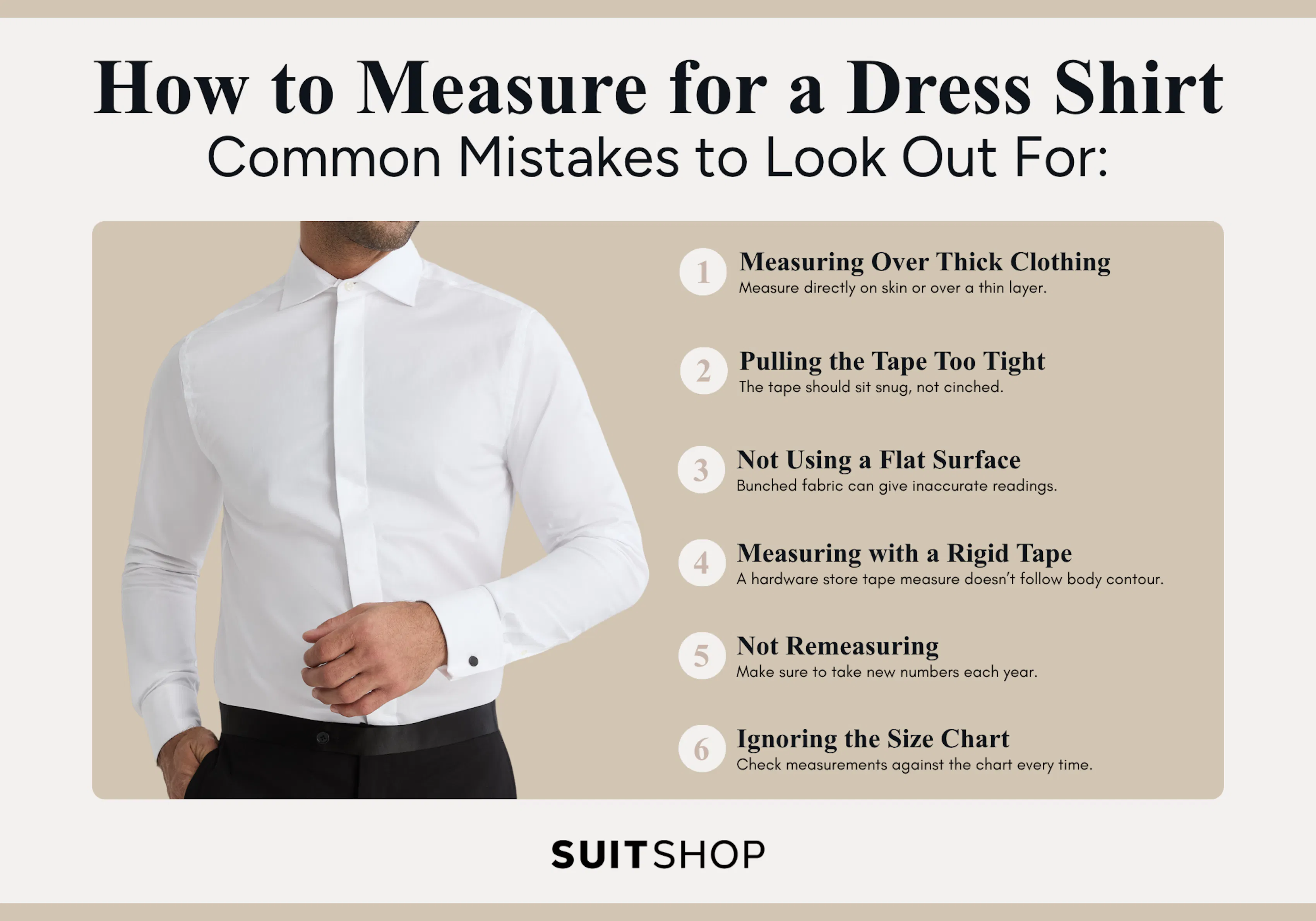
Even with a clear size chart, small errors in body measurements can push you into the wrong size. Here are the most common ones:
- Measuring over thick clothing: Measure directly on skin or over a thin layer. A heavy shirt can add an inch or more to your chest reading and throw off your dress shirt sizing entirely.
- Pulling the tape too tight: The tape should sit snug, not cinched. A too-tight neck measurement will put you in a shirt collar that digs in by the end of the day.
- Not using a flat surface when measuring a shirt directly: If you're checking the measurements of a shirt you already own, lay it on a flat surface and smooth it out before measuring. Bunched fabric gives inaccurate readings.
- Measuring with a rigid tape: A hardware store tape measure doesn't follow body contours. Use a flexible tailor's measuring tape for accurate results.
- Not remeasuring: If it's been more than a year since you last measured, take new numbers. Body measurements shift over time with changes in weight, muscle, and posture.
Ignoring the size chart: If you've always worn a Large in casual shirts, that doesn't guarantee a Large in men's dress shirts. Check your neck measurement against the chart every time.
From Measurements to a Complete Wedding Look
A well-fitted dress shirt is the foundation of a polished formal outfit, and nowhere is that more visible than at a wedding. Getting the shirt right sets the tone for everything layered over it, from the suit jacket to the tie to the pocket square.
From there, the rest of the look needs to work together. SuitShop makes that coordination straightforward. Our jackets and trousers are sized separately, so each person in a group can find the right fit for their build without compromise. And when five or more registered wedding party members order, one person gets a free, yours-to-keep suit.
Build Your Complete Look with SuitShop
You have your measurements. Now it's time to put together an outfit worth remembering.
SuitShop carries dress shirts built to pair with their full suiting lineup, along with every accessory that completes the look:
- Ties and bow ties across a wide range of colors and styles
- Pocket squares for a clean finishing detail
- Belts and suspenders to pull the waistline together
- Shoes and socks to carry the look all the way down
Whether you're building a solo outfit or coordinating a full wedding party, SuitShop's group ordering tools keep sizing, colors, and styles organized across the group without the back-and-forth.
Ready to get started? Browse SuitShop's full collection and use the Fit Finder to match your measurements to the right size.

Sean Parks
Sean Parks is a writer with a focus on men's suiting, formalwear, and personal style. Through his work with SuitShop, he has developed a deep understanding of suit fit, styling, wedding attire, and the details that help people feel confident in what they wear. A proud University of Georgia graduate with dual degrees in Public Relations and Communication Studies, Sean brings a research-driven approach to making suiting advice clear and approachable. When he's not writing about menswear, you'll find him logging miles on the Atlanta Beltline or playing the guitar on his back porch.
More Articles

The Vineyard Wedding Guide: Planning, Venues, and What to Expect
by Sean Parks September 30, 2026

Homecoming Suit Buying Guide: What to Look For and Where to Shop
by Sean Parks September 30, 2026



Customer Service
Contact Us
- Get In Touch
- Corporate Services
- +1 (773) 303-6006
- info@suitshop.com
Sign up for emails
© Copyright 2026 SuitShop