
Your Fit Problem in Sixty Seconds
Most suits don't fail bigger guys on size. They fail on proportion.
At a Glance:
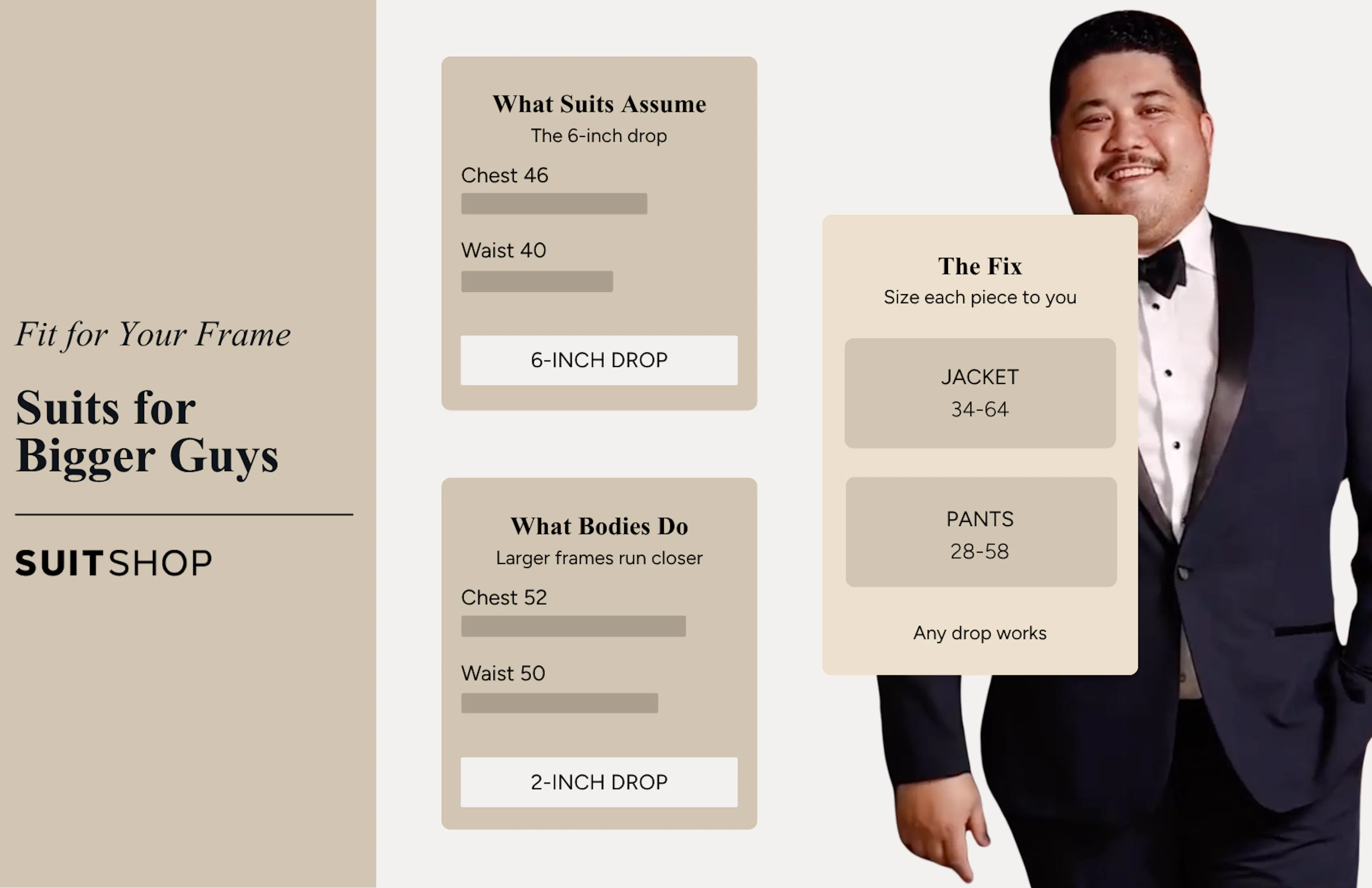
- Suits are cut to a fixed "drop," usually six inches between the chest and waist measurement.
- Larger frames often carry a much smaller drop, so a jacket that fits the chest arrives with pants that don't fit the waist.
- Measuring your chest, waist, and inseam at home takes about five minutes and a soft tape.
- Your jacket length matters as much as your chest number, and height is what determines it.
- SuitShop's Modern Fit runs from a 34 to a 64 jacket and a 28 to a 58 pant, with jackets and pants sized separately.
- A tailor should still touch three or four things after the suit arrives.
Buying a suit off the rack gets frustrating fast when nothing in the store is cut for your build. The fix starts with understanding why the sizing system works the way it does, because once you know your own numbers you can shop around the problem instead of into it.
Why Standard Suits Fail on Larger Frames
Suits are built to a drop, which is the difference in inches between the jacket's chest measurement and the waist of the pants packaged with it. American suiting has settled on a six-inch drop as the default. A 44 jacket ships with 38 waist pants, a 48 ships with a 42, and so on down the rack.
That math works if your body type happens to match it. Plenty of body types don't. The CDC's national measurement survey puts the average American man's waist at roughly 40.5 inches. Paired against a six-inch drop, that waist belongs to a 46 or 47 chest. Men who carry more weight through the midsection than the shoulders end up with a smaller drop, sometimes four inches, sometimes two, sometimes none at all.
Your chest | Waist a 6-inch drop assumes | Waist many larger frames actually have |
46 | 40 | 42 to 46 |
50 | 44 | 46 to 50 |
54 | 48 | 50 to 54 |
58 | 52 | 54 to 58 |
When your real waist sits in that right-hand column, an off-the-rack suit gives you two bad options. Size to the chest and the pants won't button. Size to the waist and the jacket hangs off your shoulders like a borrowed coat. This is why a big guy who wears an average size in every other category still can't find a suit that works, and why so much men's big and tall clothing gets written off as a lost cause before anyone checks the numbers.
How to Measure Your Chest, Waist, and Inseam at Home
You need a soft measuring tape and five minutes. Wear a dress shirt, not a sweater, and keep the tape snug without pulling it tight. Write the numbers down rather than trusting memory, because you'll use all three. SuitShop's fit guide walks through the same steps if you want a visual reference.
- Chest. Run the tape around the fullest part of your chest, under the arms and across the shoulder blades. Keep your arms down and breathe normally. Do not flex or inflate your chest, since the suit has to fit you at rest. The same technique applies when you measure for a dress shirt.
- Waist. Measure where you actually wear your pants, which for most men is at or just below the navel. This is not your ideal waist or the number on your jeans, which often runs two inches small because of vanity sizing.
- Inseam. Measure from the crotch seam to where you want the pant to break, along the inside of the leg. The easiest method is to lay a well-fitting pair of dress pants flat and measure those instead of yourself.
- Height. Stand against a wall without shoes. This determines your jacket length, and it's the measurement most guys skip.
Calculating Your Drop and What It Tells You
Subtract your waist from your chest. That number is your drop, and it tells you more about which suits will work than either measurement does alone.
A man with a 52-inch chest and a 50-inch waist has a two-inch drop. A man with a 52-inch chest and a 44 waist has an eight-inch drop. Both wear a 52 jacket. They need completely different pants, and no single boxed suit serves them both.
Your drop | What it means | What to look for |
8 inches or more | Athletic build with a tapered midsection | Jacket to your chest, pants sized down independently |
6 inches | The industry default | Most standard suits will work as sold |
4 inches | Fuller through the midsection | Jacket to your chest, pant sized up independently |
2 inches or less | Chest and waist close to even | Independent sizing is the only reliable route |
Knowing your drop also saves you money on alterations. A tailor can take a jacket in, but taking a waistband out more than about two inches runs out of fabric in the seam. Starting with the right pant size is cheaper than paying someone to invent one.
Choosing Your Jacket Length
Jacket length is set by your height, not your chest, and getting it wrong is the fastest way to look like the suit isn't yours. A jacket that runs short exposes the seat and makes the torso look boxy. One that runs long shortens the legs and swallows the frame.
There's more to how a suit jacket should fit than length alone, but length is where bigger guys go wrong first. The hem should fall around the middle of your hand when your arms hang at your sides, and it should cover the seat entirely. Sleeves should end at the wrist bone, leaving about a quarter inch of dress shirt cuff showing.
Length | Typical height range |
Short | Under 5'7" |
Regular | 5'7" to 6'0" |
Long | 6'0" to 6'3" |
Extra Long | Over 6'3" |
Bigger guys who are also tall get hit twice here. Tall men shopping a 54 or 58 chest are after the rarest combination in menswear, and most stores stock tall clothing in narrow chest sizes or wide chest sizes in regular length, but almost never both. That's how a lot of men end up with a closet full of clothes that work for every occasion except the ones that matter most. A tall suit that also carries the chest size you need is the difference between a suit that fits and a suit you tolerate. Four length options across the full size range are what puts real tall options on the table.
JP Photography
Building Your Size at SuitShop
SuitShop's Modern Fit covers jackets from a 34 to a 64 and pants from a 28 to a 58, in Short, Regular, Long, and Extra Long. Jackets and pants are sized separately, so you pick each piece against your own measurements instead of accepting whatever waist the box assigns you.
That's the practical difference for a larger frame. A 56 chest with a 54 waist is a two-inch drop that no preset suit sells, and building it takes about thirty seconds when the two pieces are ordered independently. The same applies to a 60 chest with a 50 waist at the other end.
A few things worth knowing before you order:
- The full suit and tuxedo range carries the same wide range of larger sizes, so you're not choosing between fit and color.
- Navy, grey, and black are the three classic colors that carry a larger frame well across the most occasions.
- Classic cuts in a contemporary style read cleaner on a bigger build than anything trend-driven, which is why the two-piece suit in a solid color stays the safest starting point.
- Suit jackets can be bought on their own, which means the same jacket works like a blazer or a sport coat with chinos long after the event.
- Dress pants come in a flat front cut, and flat front pants sit smoother across the midsection than pleats do on a fuller frame.
- Free fabric swatches and the online Fit Finder both exist to sort this out before anything ships, and returns and exchanges are free if a number turns out to be off.
The fabric is a performance blend that holds its shape through a long day, which matters more on a larger frame where a limp jacket collapses instead of drapes. Modern style on a bigger build comes down to clean lines and a suit that stays where you put it, not chasing whatever fashion did last season. Sophistication in a suit is mostly proportion, and proportion is a sizing problem before it's a styling one. That's the whole reason a brand built around size-inclusive suiting exists.


What a Tailor Should Still Adjust After It Arrives
Buying the right size gets you about ninety percent there. A tailor closes the last ten, and on a bigger frame the same three or four adjustments come up almost every time. Budget for an hour of a tailor's time and expect a modest bill rather than a custom suit price.
- Sleeve length. The most common alteration on any suit, and the cheapest. A quarter inch of shirt cuff should show.
- Jacket waist suppression. Taking in the side seams gives the jacket some shape through the middle without tightening the chest.
- Pant hem and break. Set this with the dress shoes you'll actually wear, since a thicker sole changes the hem by half an inch.
- Seat and thigh. Often overlooked, and it's what separates dress pants that fit from dress pants that pull.
Skip the shoulders. Reworking a shoulder seam is the one alteration that costs more than it's worth, which is why buying the right chest size in the first place matters so much.
Taking It to the Wedding
Everything above matters more when there are photographs. Wedding parties get shot from every angle for eight hours, and a jacket that gapes at the waist or a hem that drags shows up in every frame. A groomsman standing in a suit built to his own measurements looks like he belongs in the lineup rather than like he was assigned the closest available size.
The same suit covers the rest of your calendar. Formal occasions rarely announce themselves a month ahead, and owning one suit that fits means the next funeral, promotion dinner, or last-minute formal event doesn't start with a panicked search, whether you're in the wedding party or dressing as a wedding guest. Group orders make this easier rather than harder. Everyone can order the same navy suit and matching ties while each person sizes his own jacket and pants to his own body. A 38 and a 60 end up in the same photo looking equally sharp. When five or more registered wedding party members order, one member gets a free suit that's his to keep.
Find Your Size and Build the Suit
The perfect suit is a matter of knowing four numbers and shopping somewhere that carries them. Measure your chest, waist, inseam, and height, work out your drop, then build the combination that matches instead of settling for the closest preset. That's how a perfect fit happens for any occasion and any body type.
Browse SuitShop’s full collection of suits and tuxedos, pair it with a dress shirt, dress shoes, and accessories, and use the Fit Finder if any of your numbers sit between sizes. Every size from 34 to 64 sits at the same affordable prices, and every one of them is yours to keep. The comfort of a suit that fits your build is what turns getting dressed for a formal event into something you stop thinking about, and that confidence is the part people actually notice.

Sean Parks
Sean Parks is a writer with a focus on men's suiting, formalwear, and personal style. Through his work with SuitShop, he has developed a deep understanding of suit fit, styling, wedding attire, and the details that help people feel confident in what they wear. A proud University of Georgia graduate with dual degrees in Public Relations and Communication Studies, Sean brings a research-driven approach to making suiting advice clear and approachable. When he's not writing about menswear, you'll find him logging miles on the Atlanta Beltline or playing the guitar on his back porch.
More Articles

The Vineyard Wedding Guide: Planning, Venues, and What to Expect
by Sean Parks September 30, 2026

Homecoming Suit Buying Guide: What to Look For and Where to Shop
by Sean Parks September 30, 2026



Customer Service
Contact Us
- Get In Touch
- Corporate Services
- +1 (773) 303-6006
- info@suitshop.com
Sign up for emails
© Copyright 2026 SuitShop